
Most North Dakotans will never set foot on a drilling rig or analyze rocks from thousands of feet beneath the surface of the Bakken Formation, but nearly everyone in the state has benefited from what lies below. For more than two decades, the Bakken Formation in western North Dakota has helped fuel North Dakota’s economy, generating more than $35 billion in tax revenue while creating thousands of jobs across the state. But like every oil reservoir, the Bakken will eventually produce less oil as wells mature. While more than 5.9 billion barrels have already been recovered, researchers know hundreds of billions remain trapped within the rock. The challenge isn’t finding the remaining oil—it’s recovering it.
Cracking the code 2.0
Recently, the U.S. Department of Energy announced a $36 million federal award for phase one of the initiative, bringing the project’s total investment to at least $157 million through a combination of federal, state, and private funding. Led by the Energy & Environmental Research Center (EERC), Crack the Code 2.0 (CTC2.0) builds on the breakthrough that transformed the Bakken more than a decade ago. The first “code” was cracked through horizontal drilling and hydraulic fracturing, unlocking billions of barrels of oil and establishing the Bakken as a major energy resource. CTC2.0 will demonstrate enhanced oil recovery (EOR) technologies at pilot scale, generating the field data needed to advance the next stage of oil recovery in the Bakken.
For years, EERC researchers have studied EOR through laboratory research, reservoir modeling, and pilot-scale field tests. Those studies have consistently shown the potential of advanced recovery technologies to mobilize oil left behind by conventional production methods. CTC2.0 represents the next step in oil recovery by demonstrating those technologies under real-world conditions to provide the confidence needed for commercial investment.
Connecting North Dakota industries
But CTC2.0 isn’t simply about recovering more oil—it’s about strengthening North Dakota’s economy by connecting three of the state’s cornerstone industries: oil and gas, coal, and agriculture. “The strength of CTC2.0 is that it brings together decades of research, industry expertise, and North Dakota’s unique energy resources,” says Jim Sorensen, EERC Chief Research Officer, Subsurface R&D. “We know enhanced oil recovery can increase production from mature oil fields in other parts of the world, and now we have the opportunity to demonstrate these technologies at a scale that can accelerate commercial deployment in the unique conditions of the Bakken. This project is really about finding innovative ways for North Dakota’s energy industries to work together and create long-term value for the state.”
EOR relies on injecting gases into the reservoir to mobilize the next fraction of the hundreds of billions of barrels of oil remaining in the reservoir. During the project’s first phase, researchers will use produced gas from existing oil operations to evaluate EOR technologies and gather critical field data. Those demonstrations will help pave the way for the project’s long-term vision: utilizing CO2 captured from North Dakota’s coal-fired power plants and ethanol facilities for EOR.
Rather than treating CO2 solely as an emissions challenge, CTC2.0 positions CO2 as a valuable commodity. Captured CO₂ becomes a resource that recovers additional oil while creating economic opportunities for multiple industries.
For North Dakota’s coal-fired power plants, carbon dioxide’s use as a marketable product could expand dramatically, supporting continued investment in carbon capture technologies while creating additional value for coal-producing communities. Ethanol facilities would also benefit from new markets for captured CO2, further strengthening North Dakota’s agricultural economy. Oil producers gain access to the resources needed to expand EOR, extending production from one of the state’s most valuable natural resources. Instead of operating independently, these industries become connected through a shared opportunity with benefits that extend far beyond the wellhead.
The economic opportunity
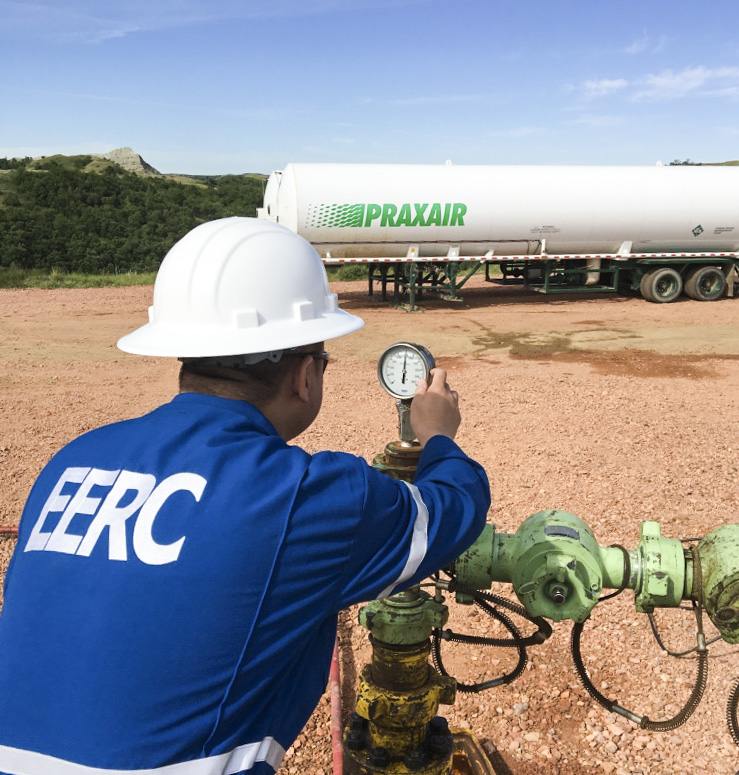
Revenue from Bakken production helps fund county roads and bridges, schools, emergency services, water infrastructure, and countless public investments across North Dakota. Extending the productive life of the Bakken means sustaining the state’s largest economic engine, and it benefits every single community in North Dakota, not just the counties where the oil is produced.
Innovation has always been one of North Dakota’s greatest strengths. From agriculture to energy production, the state’s success has come from solving difficult challenges with practical, forward-looking solutions. CTC2.0 continues that tradition by moving decades of research from the laboratory into the field, demonstrating technologies that can shape the future of North Dakota’s energy economy.
Most North Dakotans will never see the research taking place through CTC2.0. They may never think about EOR or carbon capture either. But if the project succeeds, they’ll experience its impact the same way they’ve experienced the Bakken’s impact for the past 20 years—not through the wells themselves, but through stronger communities, new economic opportunities, and continued investment in the places they call home.
Editor’s note: In 1948, Congress authorized the establishment of a national lignite research laboratory at UND. Construction of the Charles R. Robertson Lignite Research Laboratory was completed in 1951; and that’s why, in 2026, the facility — now known as the UND Energy & Environmental Research Center — is this year celebrating its 75th anniversary as a global leader in advanced energy and environmental solutions.
With the anniversary in mind, UND Today is running a series of stories to celebrate the EERC and its exceptional legacy. This week: how EERC researchers are working to advance enhanced oil recovery in the Bakken, with the potential to extend oil production while creating new connections among North Dakota’s oil and gas, coal and agriculture industries.
This story was originally published on Aug.12, 2026, on the EERC Solutions website.