
Jordan Frith, Clemson University
Few objects in the world are more immediately recognizable than the bar code. After all, bar codes are all around us. They’re on the books we buy and the packages that land on our doorsteps. More than 6 billion bar codes are scanned every single day. They’ve become such an accepted part of our daily lives that it’s hard to imagine how they could look any different.
I’ve researched various technologies throughout my career as a media studies professor, but it wasn’t until I began writing my book about the cultural history of the bar code that I realized how even the most mundane objects in our lives look the way they do because of decisions that are mostly lost to history. When I began combing through the archive of bar code history at Stony Brook University, I realized just how close we came to a world where we scan bull’s-eye or Sun symbols to buy our groceries.
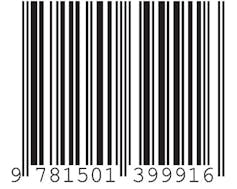
Our story begins in 1949, when Joseph Woodland and Bernard Silver submitted a patent for the first bar code. That patent described the basic structure of using pairs of lines to represent numbers that is still used in bar code technology more than 70 years later.
What their patent didn’t include, however, was anything most people today would recognize as a bar code. In fact, the first bar code didn’t include vertical lines at all. Instead, the world’s first bar code used a series of concentric circles in the shape of a bull’s-eye.
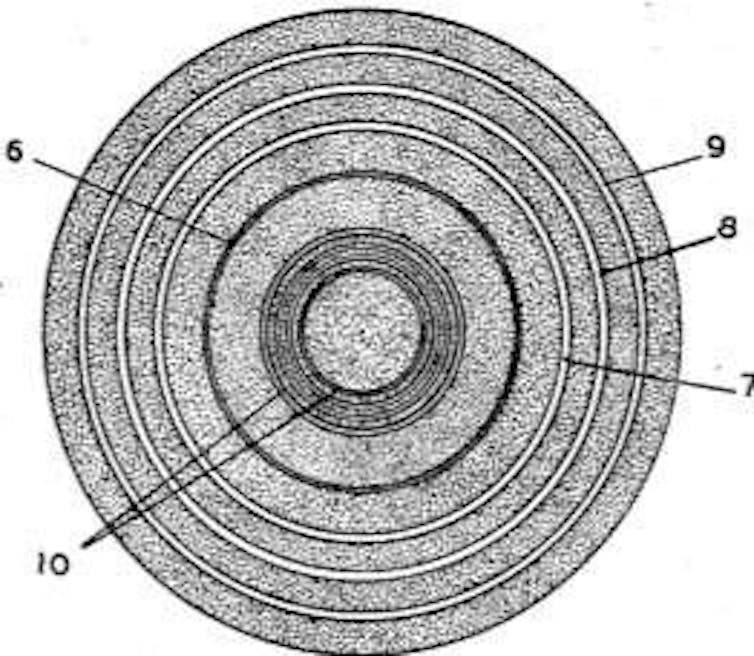
Woodland and Silver initially struggled to get companies interested in their invention. But the bar code’s fortunes began to change in 1960, when the engineer and physicist Theodore H. Maiman built the first working laser, which made it possible to quickly decode a bar code’s line patterning.
Not long afterward, in 1967, the railroad industry implemented Kartrak, which was the world’s first official bar code system. Kartrak bar codes were developed to automatically identify rail cars as they moved past scanners, but they used a design of lines of varying colors that looks more like a piece of modern art than the bar codes we use today.
But Kartrak struggled from the start – the system wasn’t as accurate as people had hoped – and it stopped being used in the 1970s. Despite being the first bar code to be officially adopted by an industry, the multicolored design of the Kartrak symbol is now just a footnote in history.
Around the same time Kartrak was launched, the grocery industry set in motion a chain of events that eventually resulted in the bar code we know today. In the late 1960s, various stores began bar code pilot projects that used vastly different types of bar code symbols.
One of the symbols was the original bull’s-eye bar code, which by that point was owned by RCA because it had purchased the patent rights. But other stores used symbols developed by other companies. For example, a company named Carecogn had developed a Sun symbol and the Litton company created a fan symbol that were part of pilot projects. The grocery industry soon realized that this Wild West period of experimentation couldn’t last.
Bar codes could work as a way to automate inventory and checkout only if everyone in the grocery industry agreed to use the same symbol. Otherwise, the system would be overly complex and expensive. So in 1971, the grocery industry formed a committee tasked with developing an industrywide data standard and choosing a symbol that stores would agree to adopt.
The data standard the committee developed – the Universal Product Code – was designed to work with different types of bar code symbols. It’s still in use 50 years later.
The committee then had to choose the symbol. They solicited applications from various companies and narrowed the pool down to seven finalists. That was when the drama really began.
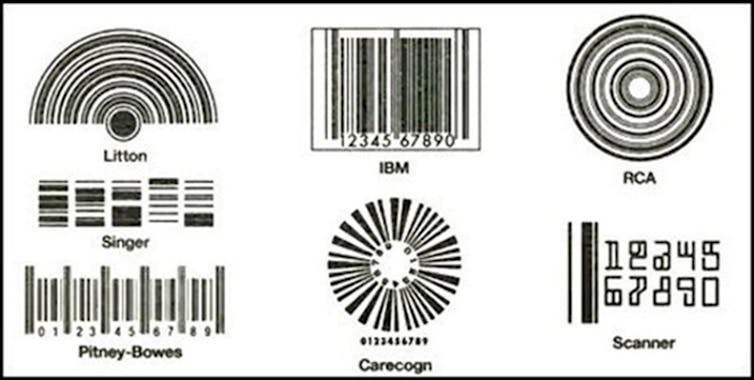
The RCA submission was the early leader among the seven finalists. The bull’s-eye bar code, after all, was the original bar code symbol, and RCA was a powerful company that had invested significant resources in developing the technology. RCA’s main competitor was a latecomer to the battle for bar code dominance: the IBM symbol invented in the early 1970s by George Laurier.
Between March 1971 and March 1973, the committee extensively tested the seven finalists, listened to pitches from each company and met multiple times to discuss the path forward. Throughout the process, RCA and IBM remained the front-runners, and in a somewhat ironic twist, Joseph Woodland – the “father of the bar code” and inventor of the bull’s-eye symbol – advocated for the IBM symbol over his own invention.
Realizing their symbol might not be selected, RCA began to pressure the committee and threatened to pull out of the bar code industry altogether if their bull’s-eye bar code was not chosen as the industry standard.
The committee’s deadline to select a symbol was March 1973, and the decision went down to the wire. In its final meeting, the committee chose the IBM symbol despite concerns that, to quote the historian Stephen Brown, “by opting for the oversquare symbol instead of the bulls-eye, the Committee may have dramatically slowed the pace of implementation” because of RCA’s pressure.
The IBM symbol became the industry standard, and the very first Universal Product Code bar code was scanned at a grocery store in Troy, Ohio, on June 26, 1974. Rather remarkably, the IBM symbol the committee chose is still going strong almost 50 years later. The bar codes you scan at a grocery store are essentially the same bar codes someone would have scanned in the 1970s.
Based on meeting notes from the symbol selection meetings, the committee members felt they were doing important work. But even in their wildest dreams, they could not have imagined how consequential their decision ended up being.
The bar code design they selected became one of the most iconic images of capitalism and has inspired architects’ building designs, symbolized dystopian conformity in science fiction, become a popular tattoo and even inspired online fan communities.
But the design that changed the world came remarkably close to being a forgotten piece of history. If a few grocery executives had voted a different way, we might be moving through a world filled with bull’s-eyes.
Jordan Frith, Pearce Professor of Professional Communication, Clemson University
This article is republished from The Conversation under a Creative Commons license. Read the original article.