
BOZEMAN – The U.S. Department of Agriculture estimates that in 2023, nearly 5.3 million acres of wheat, 1.2 million acres of barley and more than 1 million acres of pulse crops were planted in Montana. At Montana State University’s Central Agricultural Research Center, scientists are aiming to maximize the yield and profit that come from that acreage, with a focus on central Montana.
The research center, located just outside Moccasin, is the second largest of the seven facilities in MSU’s Department of Research Centers at around 600 acres. Part of the Montana Agricultural Experiment Station, it is the only center that focuses specifically on dryland research with no external irrigation systems, hosting around 60 experiments each year focused on soil health, crop rotations, organic systems and more.
Serving six Montana counties that total nearly 17,000 square miles, the 11-person staff at CARC has no shortage of inquiries to investigate. With input from area producers and guided by a farmer-led advisory council, the center has developed a diverse research program designed to make agriculture in the region as profitable and sustainable as possible in the unique geography and climate of central Montana.
“The shallow soils and their inability to hold much water make the CARC and central Montana one of the more challenging places to grow dryland crops successfully,” said Pat Carr, superintendent at the center.
Some of the programs at CARC are perennial, such as variety trials of different lines of wheat, barley and other crops to gauge how they perform under varying conditions and management practices. Scientists evaluate varieties for yield performance when exposed to harsh conditions, drought or pests and update data annually to help farmers make informed decisions when selecting which varieties to plant.
Other research projects delve more deeply into the minutiae of cropping systems. One such project of Carr’s concluded in 2023 after six years of data collection. His team planned several crop rotations that included barley, peas, canola, lentils and spring wheat, gauging the impacts of those rotations on hard red winter wheat that followed.
Ultimately, they found that planting wheat after a rotation of lentils led to improved grain yield. That effect also went in reverse, with lentils planted after spring wheat showing signs of higher yield. Because different types of rotational crops can favorably impact nutrients like nitrogen and help hold more moisture in agricultural soil, these types of rotations can be an effective approach for growers, especially those in non-irrigated systems or in areas with frequent droughts.
“Farm Service Agency data indicate that there were over 239,000 acres of wheat in Judith Basin, Cascade, Chouteau, Fergus, Meagher and Wheatland counties in 2019,” said Carr. “If we assume conservatively that 20% of that wheat was grown following a previous wheat crop, then an additional 191,000 to 230,000 bushels of wheat would have been produced in those five counties if wheat had been grown following lentils. That translates to around $1 million in additional income generation for central Montana farmers.”
As MSU’s research centers expand explorations into precision agriculture, scientists at CARC are also examining plant-microbe interactions to gauge how efficiently crops can use inputs such as fertilizers or other supplements. Associate professor Jed Eberly has been studying agronomy and microbiology at CARC for more than seven years, with current projects focused on identifying the genetic tools barley plants use to efficiently absorb nutrients and tolerate stresses such as drought.
“Current gains in crop productivity through breeding are insufficient to meet future food demand,” said Eberly. “Reduced inputs are also required to increase sustainability of agroecosystems. Our work seeks to understand the effect of genetic and environmental interactions on the microbial community associated with barley roots.”
Eberly’s team has identified beneficial microorganisms and the genetic pathways that plants use to collect and process those microorganisms. With this knowledge, Eberly said, plant breeders have additional variables that they can target when developing new varieties, which they hope will result in future crop lines that are naturally better at absorbing those important micronutrients.
For Carr, who received his doctorate from MSU and has been the superintendent at CARC since 2016, the mission of the research centers is driven by not only advisory councils but, critically, by members of the local agricultural community who provide input and ask questions, guiding research projects based on their local needs.
“My wife and I jumped at the chance to return to Montana so we could be a part of MSU’s mission of serving the state’s farming and ranching communities,” he said. “Working at the center places me and others at MSU research centers in the rural communities that we should be serving. Our proximity to farmers and ranchers can help direct us to the research that we should be doing.”
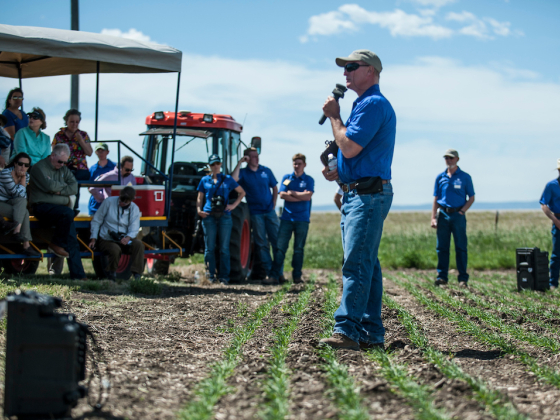
Engaging with the nearby communities takes many forms, from the center’s annual winter research roundup to collaborations with county MSU Extension offices to disseminate new knowledge and host educational sessions. CARC will host its annual summer field day as part of the larger MAES field day series on Wednesday, June 26 at 8:30 a.m. at the center in Moccasin. All field day events are free and open to the public, including a meal, facility tours and presentations on ongoing research projects.